
The History of Language
Idioms Week 3-To Spill the Beans
.png)
Idiom of the Week! – Spill the Beans
This activity strengthens students’ speaking and listening skills. Use the video as a spark for discussion. Ask open-ended questions like, “Have you ever heard someone let a secret slip by accident?” or “Why might keeping a secret be important sometimes?” Encourage students to share stories respectfully and practise listening carefully to others. This is a great chance to develop empathy, reflection, and confident self-expression.
Focus: Speaking & Listening
Watch Gavin’s short video to discover where the saying “spill the beans” really comes from. It might sound silly, but it all started with a serious secret, a jar full of beans, and a clumsy moment in Ancient Greece!
After the video, turn to a partner and talk about what you found interesting. Have you ever accidentally told a secret you weren’t meant to share? How did it feel? What happened afterwards? Be ready to share your thoughts with the class.
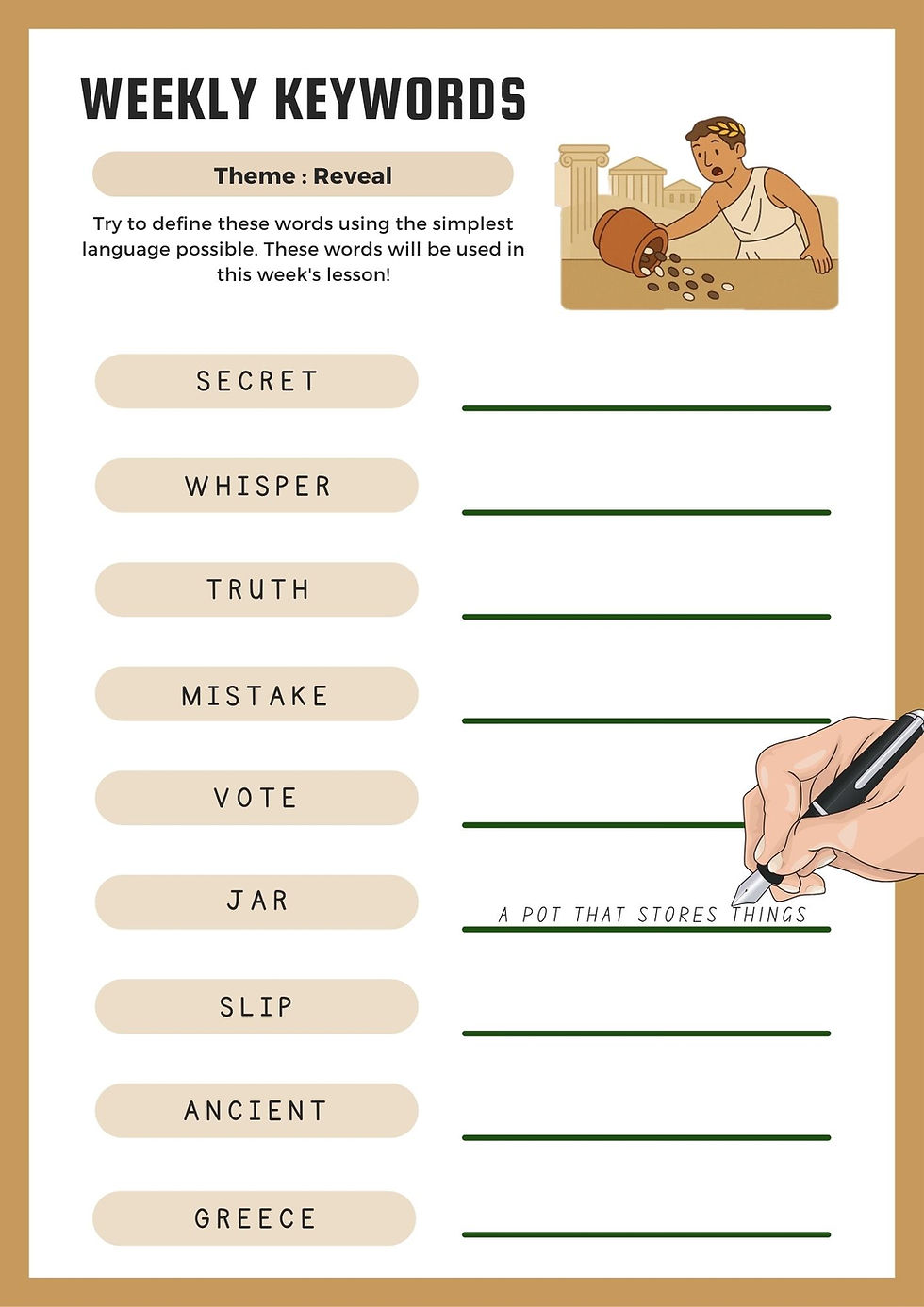
Vocabulary – Weekly Keywords
This task helps children explore new vocabulary in a meaningful context. Start by reading the ten words aloud together and discussing any that are unfamiliar. Encourage children to define the words using their own language to promote ownership and deepen understanding. Link the vocabulary back to the story of Ancient Greece and the spilled beans to make each word relevant and memorable. A quick sketch helps visual learners build lasting connections.
Focus: Vocabulary Building
Here are your ten powerful words for the week:
secret, whisper, truth, mistake, vote, jar, slip, reveal, ancient, and Greece.
Find out what each word means by looking it up or asking someone.
Write a short definition in your own words.
Use each word in a sentence that shows you understand it.
Choose one of the words and draw a little sketch to help you remember it.
Quote of the Week
This task encourages thoughtful reflection and analysis. Begin with a short class discussion about Franklin’s quote—ask students what it suggests about secrets and why they’re so hard to keep. Prompt comparisons with the idiom’s origin story to help them connect ideas across different texts. Encourage children to back up their interpretations with reasoning or examples. This activity helps build critical thinking, emotional intelligence, and ethical awareness.
Focus: Critical Thinking
Read this quote with a friend:
“Honesty is the first chapter in the book of wisdom.” – Thomas Jefferson
Have a chat about what you think it means. Why do you think Franklin was warning us about the danger of shared secrets? How does this quote connect to the story of someone accidentally spilling a jar of voting beans in Ancient Greece? What does it teach us about trust, responsibility, and the power of words?
Now, using the quote card template provided, find a new quote about honesty, trust, or responsibility from another famous person. Add their quote to your card, decorate it, and display it proudly in your classroom or school hallway.

Idiom Card – Where Did It Come From?
Students build contextual understanding of the idiom by exploring its historical and cultural origins. Read the story of the voting beans together, pausing to clarify unfamiliar concepts (e.g., secret ballots, Ancient Greek customs). Invite students to make inferences: What might it have felt like to witness a vote revealed too early? How would this affect the group’s trust? Encourage them to compare that with modern situations where secrets or decisions are exposed before the right time.
Focus: Reading Comprehension
Did you know this saying goes all the way back to Ancient Greece? In those days, people often voted in secret by dropping either a white or black bean into a jar. White meant “yes,” and black meant “no.” But if someone knocked the jar over before the votes were counted… well, the secret was out!
That’s how the idiom “spill the beans” began—it meant to reveal something that was supposed to stay hidden.

Comprehension History Card – Life Back Then
Students build contextual understanding of the idiom by stepping into the world where it originated. Read the history card together and pause to explore new vocabulary or cultural references. Encourage children to visualise life in Ancient Greece—how people lived, what they believed in, and how public decision-making worked. Invite comparisons between their world and ours, focusing on the idea of secrets, votes, and community.
Focus: Reading Comprehension
Let’s travel back over 2,000 years to Ancient Greece! Imagine walking through a busy marketplace—what would you see, smell, and hear? Would there be merchants selling olives and figs, the sound of sandals on dusty stone streets, or philosophers debating under shaded trees?
Read your history card to learn all about daily life in Ancient Greece. Then, answer the questions and imagine what your life might have been like. Would you be a potter, a scholar, a soldier, or perhaps the person in charge of counting the voting beans?
Write a few sentences describing a day in your life in Ancient Greece. What would you wear? What would you eat? Where would you go?


Write Your Answers
This activity encourages children to reflect on a historical scene and answer comprehension questions in full sentences. It promotes critical thinking, sentence construction, and historical understanding. The accompanying answer card provides structure and motivation, allowing students to work at their own pace in a calm, independent, and confidence-building environment.
Focus - Comprehension and Collaboration
Use this card to record your answers from the comprehension questions above.
Remember to try and write in full sentences and get as far as you can.
Get a Move on!!!

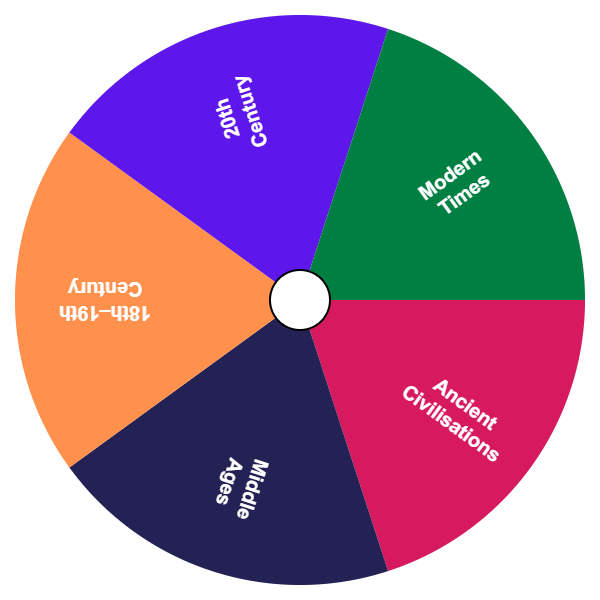
Spin the Wheel and Choose Your Idiom!
During this activity, allow the children to use the wheel to determine which era they’ll explore for their idiom of choice. The element of surprise adds excitement and a sense of adventure to their learning journey.
Encourage fun and laughter as the wheel spins — build the suspense, cheer together, and make it feel like a moment of celebration! At the same time, make sure the children feel a sense of ownership. Give them freedom to dive into their era in a way that feels right for them.
Each week, you'll have the chance to dive into a new idiom from a different moment in history — all revealed in the next part of this sequence.
But first… let’s leave it up to fate!
Spin the wheel and let random chance decide which era you’ll be exploring. Once your time period is revealed, head to the matching card in the next section of this lesson and discover an idiom worth unravelling.
Spin the wheel… and hold on tight!
Choose This Week's Idiom to Research
Each week, students independently select an idiom to explore, diving into its origin, meaning, and cultural background. Encourage curiosity and independence as they research, whether through books, videos, or trusted websites. Highlight how idioms like “spill the beans” offer glimpses into ancient customs and language evolution. This task fosters self-directed learning, cross-curricular thinking, and confident communication.
Focus: Independent Research
Each week, you’ll get to choose a new idiom to investigate—just like we did with “spill the beans.” The study of word origins (called etymology) helps us uncover fascinating stories hidden in everyday phrases.
Some idioms come from ancient times, like secret voting with beans in Greece, while others come from battles, inventions, or even animals!
Take a look at the idiom menu and choose one that sounds fun, mysterious, or meaningful to you. You’ll research where it came from, what it means, and how it’s used today. Then, you’ll share your findings in a creative way.
.png)
Choose an Idiom – Make Your Own Comic
This task encourages inquiry, summarising, and creative storytelling. Begin by sharing a few playful idioms as a class to inspire imagination. Offer a list or allow students to choose their own idiom to research. Support those who need help with sentence starters (e.g., “I didn’t mean to say it, but...”) and model how a comic sequence flows. Use a four-panel template to provide structure and ensure that each story has a beginning, middle, and end.
Focus: Independent Research and Creative Arts
Now it’s your turn to become a comic creator!
Pick a new idiom—just like “spill the beans”—that sounds funny, dramatic, or surprising. Find out where it comes from and what it actually means. Once you’ve got a clear understanding, it’s time to bring your idiom to life in a four-panel comic strip.
Show a character using the idiom in either a real-life or completely silly situation. Maybe someone accidentally blurts out a surprise party secret, or a chef literally spills a can of beans! Each panel should include a speech bubble to help tell the story clearly and creatively.

Let’s Vote! – A New School Rule
This task connects history with citizenship, giving students agency in a real-life democratic process. Begin with a discussion on the value of rules and how decisions were made in Ancient Greece. Support students in brainstorming rules that promote kindness, safety, or fairness. Guide them to write persuasive proposals and practise respectful presentation skills. The secret vote adds a layer of excitement and historical authenticity, while reinforcing lessons in privacy, honesty, and integrity.
Focus: Creative Communication and Teamwork
This week, you’re taking on an exciting challenge: helping your school decide on a brand-new rule! But just like in Ancient Greece, where secret votes were cast with beans, we’ll be holding our own version of a secret school vote.
Step 1: Work in teams to come up with a new rule that would make your school a better place—something fair, helpful, and respectful.
Step 2: Write your proposal clearly and present it to the class using speaking and listening skills.
Step 3: We’ll then hold a secret classroom vote—no one will know who voted for what until we reveal the results.
Remember: Think carefully, speak kindly, and don’t spill the beans before the results are in!
.png)
Teach a Lesson – You’re the Teacher!
his activity encourages students to take ownership of their learning and build confidence by teaching others. Guide them in structuring their mini-lesson with a beginning, middle, and end. Encourage them to use visual or performance elements, and support peer-teaching opportunities across classes or groups. This task strengthens empathy, creativity, and communication—essential leadership skills for life.
Focus: Leadership & Teaching Skills
Now it’s your turn to teach! Create a fun mini-lesson to explain the idiom “spill the beans” to a younger child or a classmate. You can use a drawing, a skit, a puppet show, or even design a mini-game to bring your explanation to life.
Make sure your lesson includes:
What the idiom means
Where it came from (the Ancient Greek voting system!)
A fun or realistic example of it being used
Teaching someone else is one of the best ways to understand something deeply—so get creative, enjoy yourself, and let your lesson shine like a well-polished pot in the Athenian sun!

Art Therapy – Life in Ancient Greece
This activity invites children to step into the world of Ancient Greece through careful observation and creative expression. Provide a detailed black-and-white scene from a marketplace, a voting session, or a public gathering. Allow time for quiet reflection, encouraging children to focus on the small details. Use this as a moment of calm within the week’s learning—an opportunity to foster mindfulness, build historical empathy, and deepen their connection to the past through art.
Focus: Quiet Reflection
Take a moment to explore this peaceful scene showing everyday life in Ancient Greece.
What details stand out to you? What do you think the people in the image are doing? Why might life have looked like this back then? Can you spot anything related to democracy, learning, or trade?
Once you’ve studied the picture carefully, use the black-and-white template to create your own version. Find a quiet, calm place—perhaps in the library—and settle in with some soft music if you like. Let this be your moment to slow down, breathe deeply, and travel back in time with your imagination.
As you bring the scene to life with colour, reflect on how you feel—curious, calm, or inspired. Let your thoughts wander through the stone-paved streets, the sunlit temples, and the quiet moments of ancient life.


Quiz and Certificate
Click here to complete a simple quiz on life in Ancient Greece and the origins of the idiom “Spill the Beans.”
Put your knowledge to the test—what have you learned about secrets, voting with beans, and the culture of Ancient Greece?
Complete the quiz, and once you’ve finished, you’ll receive your official certificate to celebrate your journey into the past!