
Rewild the Wild
Week 10 - Taking Responsibility and Using Your Voice
.png)
Week 10 – Taking Responsibility and Using Your Voice
This final week shifts the focus from learning and action to reflection, responsibility and advocacy. It is designed to help students recognise their growth and understand their capacity to influence the world around them.
Begin by revisiting the journey students have taken across the programme. They have moved from observing nature to actively contributing to it through their Wild Projects. This week helps them step back and recognise that their actions have meaning and impact.
Effective Questioning: Responsibility
What responsibilities do we already have at school or home?
How can our choices affect the environment?
What does responsibility look like in our habitat project?
How have you shown responsibility this term?
Introduce the concept of responsibility in a way that feels empowering rather than overwhelming. Students should understand that responsibility is not about pressure, but about recognising that their choices matter.
Advocacy should be framed as using your voice with purpose. This may include sharing ideas, telling stories, encouraging others or taking action to protect something important.
Effective Questioning: Advocacy
How can young people use their voice positively?
What issues in nature would you speak up for?
How can sharing ideas help create change?
Do you need to be an adult to be an advocate? Why not?
What message would you share with others?
Over the past ten weeks, you have explored the natural world in a new way.
You have learned about habitats, biodiversity and how living things depend on each other. You have observed carefully, asked questions and taken real action to help wildlife in your school. Now, it is time to think about something even bigger.
This week is about responsibility. Responsibility means understanding that your choices and actions can affect other people, animals and the environment. It means doing the right thing and helping care for what matters. It is about understanding that our choices matter, and that even small actions can make a difference.
It is also about advocacy. Advocacy means using your voice to stand up for something you care about. Throughout this week, you will reflect on what you have learned, think about how your actions have helped the environment and share your story with others.
You are not just learning about the world anymore. You are becoming someone who can help shape it.
Your Weekly Keywords
This activity introduces vocabulary connected to human behaviour and environmental responsibility. The purpose is to help students understand that the health of ecosystems is influenced not only by natural processes but also by the choices people make in their everyday lives.
Begin by reminding students of the journey they have taken throughout the Rewild Your World programme. They have explored habitats, studied biodiversity and built Wild Projects that may support wildlife in their school environment. This final week shifts the focus slightly toward human behaviour and how our habits, choices and actions can affect the natural world.
Introduce the keywords and read them aloud together. Encourage students to think about what each word might mean before looking at the definitions.
Invite them to share their ideas and explain their reasoning. This helps activate prior knowledge and encourages discussion.
Students should work with a partner to suggest simple definitions and use the words in sentences. Encourage them to connect the vocabulary to real situations, such as recycling, choosing sustainable products or reducing waste.
This week, your keywords will help you think about how people’s choices and actions can affect the natural world.
Over the past weeks, you have learned about habitats, biodiversity and how animals depend on healthy ecosystems. You also worked together to build Wild Projects that may help wildlife in your school habitat. Some of this week’s words describe the choices people make. Others explain how our actions, habits and decisions can influence the environment around us.
First, read each keyword carefully. Then, try to explain what the word means using simple language. Talk with a partner and share your ideas. Try using each word in a sentence.
As you work, think about questions like these:
What does this word tell us about how people behave?
How can our choices help protect nature?
What actions can people take to care for the planet?
By the end of this task, you will better understand how everyday choices can make a difference for wildlife and the environment.
.png)
Quote of the Week – The Palau Pledge
This activity introduces students to the Palau Pledge, a real environmental commitment required of visitors to the Pacific island nation of Palau. The pledge was created with input from the children of Palau to encourage travellers to respect and protect their environment.
Begin by explaining that many places around the world rely on tourism but also need to protect fragile ecosystems such as coral reefs, forests and wildlife habitats. The Palau Pledge was created to remind visitors that exploring nature comes with responsibility.
Read the pledge aloud and allow students a moment to reflect on the language used. Encourage students to notice phrases such as “tread lightly”, “act kindly” and “leave only footprints that will wash away”.
Support students to use critical thinking when evaluating why communities create pledges and how human choices can protect or harm environments.
Guide discussion with questions such as:
What do you think it means to tread lightly in nature?
Why might children have helped create this pledge?
How can visitors explore nature without damaging it?
What promises could we make when visiting natural places?
This quote comes from the Palau Pledge. Visitors who travel to the island nation of Palau promise to respect and protect the natural environment.
The pledge reminds people that when we explore nature, we must also care for it. Read the pledge carefully and think about what it means.
Why do you think visitors are asked to make this promise?
Talk with your class about how people can explore the world while protecting it. After your discussion, use the template opposite to create your own pledge for a place that you think needs protecting.
.png)
Rewilding the World – The Turtles That Follow the Stars
Introduce this story as a real example of how small changes in human behaviour can help protect wildlife. Explain that baby loggerhead turtles have been hatching on Queensland beaches for thousands of years and rely on the natural light of the moon and stars to guide them to the ocean.
Guide students to notice how the story begins with the life cycle of the turtles. The hatchlings break out of their eggs, dig through the sand and begin their important journey toward the sea. Highlight how this journey is guided by the natural glow of the horizon over the water.
Encourage students to think about how human activity can sometimes change natural environments. Bright lights from houses, roads and buildings can confuse young turtles and cause them to crawl away from the ocean.
Discuss how communities have worked together to help solve this problem. Special turtle-friendly lights, turning off unnecessary lights and protecting nesting beaches are examples of how people can support wildlife.
This week, you will read a true story about baby turtles and how people are helping them find their way to the ocean.
Imagine a quiet beach in Queensland on a warm summer night. Beneath the sand, tiny loggerhead turtle hatchlings begin to move inside their eggs. Soon, they break out of their shells and dig up through the sand together. When they reach the surface, the hatchlings must quickly crawl to the ocean.
For thousands of years, baby turtles have used the moon and stars to guide them. The light over the ocean helps them move in the right direction. But today, many beaches are much brighter than they used to be. Lights from houses, streets and buildings can confuse the turtles. Some crawl toward these lights instead of the ocean and may not survive the journey.
As you read the story, notice how communities in Queensland are helping solve this problem. Special turtle-friendly lights are used near beaches, and people are encouraged to switch off bright lights during nesting season.
Think about why darkness at night is important for turtles and many other animals. After reading, be ready to share one interesting thing you learned and explain how people can help protect wildlife by making small changes.


Comprehension – Understanding A Sustainable Future
Introduce this text as a real and relevant exploration of how human choices shape the world around us. Emphasise that students are not just learning about problems, but about their own power to create change.
Guide students to notice the structure of the text. It begins by explaining humans as ecosystem engineers, then explores the consequences of our actions, before moving into solutions through the 10 R’s and everyday choices.
Encourage students to focus on key concepts such as ecosystem engineers, biodiversity, habitat loss and the idea of a negative feedback loop. These may be new ideas, so allow time for discussion and examples.
Use questioning to deepen understanding:
What does it mean to be an ecosystem engineer?
How can small actions lead to big environmental changes?
What is a negative feedback loop and why is it important?
How do the 10 R’s help us make better choices?
This week, you will read an information text about how humans shape the planet and how our choices can support or harm the environment.
As you read, think carefully about what it means to be an ecosystem engineer. Notice how humans change landscapes, ecosystems and even the atmosphere through the way we live, build and create. Pay attention to the idea of a negative feedback loop. Notice how harming nature can make the Earth less able to support life, and how this can affect both people and wildlife.
You will also learn about the 10 R’s and how they guide us to make better choices. Think about how actions like refuse, reduce, reuse and rewild can help protect and restore the planet.
As you read, notice how small everyday decisions, such as what we buy, eat and use, can become part of a much bigger global impact. Consider how individual actions connect to larger systems like farming, cities and industry.
Work your way through the comprehension questions and see how far you can progress through the levels. Try to make it all the way to the end. The answer section is in the next part of this learning sequence.


Record Your Answers – How Far Will You Stretch Your Thinking?
This activity focuses on students reflecting on sustainability and understanding how human choices impact the environment. The purpose is to move beyond simple recall and support deeper thinking about responsibility and action.
Begin by reminding students that this task is about thinking carefully, not working quickly. The questions are designed to help them reflect on what they have learned about waste, sustainable choices and protecting ecosystems.
Before students begin, model how to answer one question using a full sentence and clear reasoning. Show students how to explain their thinking rather than giving very short or incomplete answers. Students may wish to work in pairs to clarify their ideas before writing their answers.
As students work, encourage them to:
Read each question carefully.
Take time to think before answering.
Explain their ideas clearly.
Connect their answers to real-life examples where possible.
Look for:
Understanding of key sustainability ideas such as reducing waste and making responsible choices.
Ability to explain why certain actions help the environment.
Connections between human behaviour and ecosystem health.
Thoughtful responses rather than rushed answers.
Introduce this text as a real and relevant exploration of how human choices shape the world around us. Emphasise that students are not just learning about problems, but about their own power to create change.
Guide students to notice the structure of the text. It begins by explaining humans as ecosystem engineers, then explores the consequences of our actions, before moving into solutions through the 10 R’s and everyday choices.
Encourage students to focus on key concepts such as ecosystem engineers, biodiversity, habitat loss and the idea of a negative feedback loop. These may be new ideas, so allow time for discussion and examples.
Use questioning to deepen understanding:
What does it mean to be an ecosystem engineer?
How can small actions lead to big environmental changes?
What is a negative feedback loop and why is it important?
How do the 10 R’s help us make better choices?


What is its Environmental Footprint?
This activity helps students understand that every product has a “life story” and that each stage—raw materials, production, transport, use and disposal—has environmental impacts. Students investigate these stages to uncover the product’s environmental footprint and consider more sustainable choices.
Assist students to:
Understand the concept of an environmental footprint
Analyse the life cycle of a product (supply chain thinking)
Identify impacts on biodiversity, climate, resources and people
Develop critical thinking about consumption and sustainability
As students develop the mind map allow them to follow their thoughts and realisations: for example for a bottle of orange juice you would have multiple packaging considerations: the bottle, printing the label, how the label is attached, the lid (usually of a different material to the bottle), how these are amassed for supply (in boxes which are themselves manufactured and printed). These would also have different disposal considerations at the end of their life.
Consider how the environmental footprint could be reduced at a personal level E.g. Buying locally produced rather than imported, opting for products made from recyclable materials, choosing organic orange juice rather than juice relying on chemical use and other sustainable methods at a manufacturing level.
Encourage students to connect this learning to their own choices. Even small decisions—buying local, reducing waste, choosing reusable items—can reduce their environmental footprint.
Every product we use has a story. Before it reaches our hands, it has travelled through a long journey—from raw materials in the ground or grown on farms, to factories where it is made, then transported, packaged and eventually used and thrown away. Along this journey, energy and resources are used, and this creates an environmental footprint—the impact that product has on the planet.
In this activity, you will work in groups to become investigators of that journey. Choose a common product and map out its life from beginning to end. As you follow each stage—where materials come from, how it is produced, how far it travels, and what happens when it is discarded— identify the environmental impacts along the way.
By the end of this unit, you will be able to identify the environmental impacts of everyday items and describe how your choices can help reduce these impacts.


Photopoint Monitoring – Tracking Change Over Time
This activity introduces students to the concept of long-term environmental monitoring through photopoint observation. It is designed to help students understand that ecological change happens gradually over time and requires patience and consistency to observe.
Begin by explaining that scientists often return to the same location to record changes in ecosystems. Photopoint monitoring is a simple and effective way to do this by capturing images from the same position over an extended period.
Support students to select a clear and consistent location within the school habitat. This should be an area where change is likely to occur, such as near planting zones or Wild Project installations.
Model how to take a photo from a fixed position. Emphasise the importance of:
Standing in the same place each time.
Keeping the same angle and framing.
Taking photos at a similar time of day where possible.
The test card should be used as a visual guide to help students align their photos consistently. Taking it from a fence post, corner of a building or other fixed spot is helpful.
Students will take an initial baseline photo and then continue capturing images over the coming months. These images can be uploaded and stored to allow for comparison over time.
This week, you will begin a long-term project to observe how your habitat changes over time. You will use photopoint monitoring to record your progress. This means taking a photo from the same place each time so you can clearly see what changes.
First, choose a spot in your school habitat. This should be a place where your Wild Projects are and the plants are growing. Stand in the same position each time and take your photo from the same angle. Try to take your photo at a similar time of day. Use your test card to help you line up your photo so it looks the same each time. You will take your first photo this week.
Then, you will return to the same spot over the next months to take more photos. Upload your images each time so you can compare them and see how your habitat grows and changes.
As you do this, think about and record:
What changes you can see.
What plants are growing.
What animals or insects might be visiting.
How your habitat is improving over time.
This is one helpful way scientists can observe change in the real world.


Using iNaturalist – Discovering Wildlife Around You
This activity introduces students to iNaturalist as a tool for observing and identifying biodiversity within their environment. It also builds an understanding of citizen science and how individual observations can contribute to global research.
Students will have been introduced to the app through the video. Teachers should refer to school policies when using digital tools that request login details; however, the app can be used under a class login rather than individual accounts. This activity reinforces their understanding and prepares them to use iNaturalist independently during future biodiversity surveys.
Begin by revisiting the purpose of iNaturalist. Explain that scientists cannot be everywhere at once, so they rely on people around the world to collect and share observations of plants and animals.
Demonstrate how to use the app if needed, focusing on:
Taking a clear photo of an organism.
Allowing the app to suggest an identification.
Uploading the observation.
Understanding that other users may help confirm the species.
Emphasise that observations should be made without disturbing wildlife. This reinforces respectful and ethical behaviour when interacting with nature.
This week, you will learn how to use iNaturalist to explore the wildlife in your habitat.
iNaturalist is an app that helps you identify plants, animals and insects by taking a photo. It allows you to learn about living things without disturbing them. When you see an insect, bird or animal, carefully take a photo using the app. The app will suggest what it might be, and other people can help confirm your observation.
Each time you upload a photo, you are helping scientists learn more about where different species live. You will use this skill in a future activity when you complete a biodiversity survey of your habitat.
As you use iNaturalist, remember:
Take clear photos without touching or disturbing animals.
Observe carefully before you take your photo.
Check the suggested identification.
Upload your observation to share your findings.
By doing this, you are becoming a citizen scientist and helping protect biodiversity.
Biodiversity Survey – Discovering Life in Your Habitat
This activity builds observation, curiosity and connection to the natural world. Students begin to understand habitats, biodiversity and how environments change over time.
Preparation
Check the habitat for safety and set clear boundaries.
Introduce respectful observation and care for living things.
Model how to use the recording table and iNaturalist or noting key features of an animal for identification.
Discuss animal groups and simple classification.
Remind students to be quiet and avoid moving too much to scare away animals.
During the Activity
Encourage slow, careful observation rather than rushing.
Prompt thinking with questions such as “What do you notice?” and “What is it doing?”
Support estimation when counting large numbers.
Reassure students that it is okay not to know the species name—you can use the invertebrate card from the invertebrate search for identification assistance.
Encourage photos, sketches and note-taking descriptive language to help identify the species later.
Organisation
Use small groups to support collaboration.
Assign roles such as observer, recorder and photographer if helpful.
Rotate roles across different survey times.
Reflection and Discussion
Share findings as a class and compare observations.
Track changes over time and link to seasons and weather.
Encourage students to ask questions and form ideas about why changes are happening.
At the completion of each survey, use the template provided to create a visual representation of the data via a graph.
Now, it’s time to begin your biodiversity survey and see how your habitat changes over time.
You will explore your habitat and look carefully for living things like insects, birds, reptiles and other animals. Move slowly, look closely and take your time to notice what is around you. When you find something, you can use iNaturalist to take a photo and help you identify it, or take notes on its key features to look up in a reference book at a later time. Then, record what you find in your table.
For each observation, write:
What class (group) it belongs to, such as insect, bird or reptile.
The name of the species if you know it.
How many you can see.
What the animal is doing.
Anything interesting you notice about it.
You will complete this survey at different times:
1 week
1 month
3 months
6 months
8 months
Each time, return to the same habitat and repeat your observations so you can compare your results. As time goes on, you might notice more animals and insects starting to live in your habitat as it grows and becomes a safe place for them.
After collecting your data, you will create a graph to show how biodiversity has changed over time. This will help you clearly see how your habitat is growing and supporting more life. If you would like to challenge yourself even further, you can click on the Extension Maths Activity button. This is optional and will help you explore your data in more depth by looking for patterns and changes over time.


Share Your Story – Create Your Video
This activity is designed as a reflective and expressive conclusion to the learning journey. It allows students to consolidate their experiences, articulate personal growth and connect their actions to a wider purpose.
Begin by explaining that this is not about creating a perfect video. The focus is on authentic reflection and student voice. Encourage students to speak from their own experience. You may wish to model a simple example by sharing a short personal reflection.
Support students to structure their thinking using prompts:
What did I do?
What did I learn?
How did I feel?
How have I changed?
Why does this matter?
A call to action: What would they like others to do? They may like to include a slogan, motto, catchphrase or directive.
Allow flexibility in how students present their videos. Some may choose to speak to the camera, while others may prefer to film their habitat and narrate. If using Canva, provide basic guidance but keep the focus on storytelling rather than design.
Now, it is time to share your journey with the world.
Start by thinking back over everything you have done during Rewild Your World. Remember your key moments and choose the message you want to share. Write a few short bullet points to help you organise your ideas. Think about what you created, what you learned and how you felt along the way.
Next, prepare your recording space. Choose a quiet place and decide if you will film yourself, your habitat, or both. When you are ready, record your video. Speak clearly and take your time.
Try to explain:
What you did.
How you felt.
What you learned.
How you have changed.
Why this work matters.
A call to action.
You can use Canva to edit your video if you would like. When your video is ready, upload it to the Dear World Library and share your story with others. Your voice can inspire people around the world to care for nature and take action.
.png)
Start a Nature Club – Invite Others to Join
This activity extends students’ learning from action into leadership and long-term responsibility. It supports the transition from participating in a project to sustaining and sharing it with others.
Begin by explaining that the Nature Club is not just an activity, but an ongoing commitment. Students are taking ownership of the habitat they have created and becoming caretakers of the space. The school can also include the activities of the club towards the Jane Goodall Institute accreditation program.
Frame the Nature Club around three key purposes:
Caring for the habitat.
Observing and monitoring change.
Sharing knowledge with others.
Discuss what this might look like in practice. Students may identify tasks such as checking structures, observing biodiversity, recording changes, and guiding visiting classes through the space.
The poster design task introduces advocacy. Students are using communication to invite others to join a meaningful cause. Encourage them to think about audience and purpose. The goal is to attract interest and clearly explain why the Nature Club matters.
Support students to include key information: * What the Nature Club is.
What members will do.
Why it is important.
When and where it will take place.
Encourage creativity, but keep the focus on clarity of message rather than decoration.
Your work does not stop here.
This week, you are going to help start a Nature Club at your school. The Nature Club will take care of your habitat and continue the work you have started.
Each week, members will visit the habitat to:
Look for changes over time.
Check if anything needs fixing or improving.
Observe new insects, animals and plants.
Learn more about how the habitat is growing.
As part of the Nature Club, you will also help teach others. When other classes visit, you can guide them through the habitat and share what you know about the living things you find there.
Your job now is to design a poster to invite others to join your Nature Club. Your poster should:
Have a clear title.
Explain what the Nature Club does.
Tell people why they should join.
Include when and where it will happen.
Make people feel excited to be part of it.
Think about how you can make your poster stand out so others want to join. Once your club is formed, you might choose to create membership cards or badges to make it official. This is your chance to lead, take responsibility and inspire others to care for nature.

Weekly Mindfulness – A Wild School
This activity invites students to reflect on the long-term impact of their learning by imagining a future where their school environment has become a thriving habitat for wildlife.
Begin by encouraging students to slow down and carefully observe the image. This is not a task about artistic skill but about thoughtful imagination and connection to nature.
Guide students to think about how their Wild Projects and small actions could grow over time. Help them consider how plants, insects, birds and animals might return and begin to use the habitat spaces created.
Encourage students to include a range of elements in their drawings, such as:
Habitat structures.
Native plants and flowers.
Insects, birds or small animals.
Spaces where people and nature exist together.
Students should also add simple written descriptions to explain their thinking.
Look for:
Imaginative but realistic ideas about ecosystems.
Connections between human action and environmental change.
Growing understanding of biodiversity.
Calm focus and attention to detail.
The purpose of this activity is to help students see that environmental change takes time and that their actions can contribute to a healthier future.
This week, you will take a quiet moment to imagine the future of your school.
Find a calm space and look closely at the image. Notice the plants, the animals and the habitat spaces that have been created. Now, imagine your own school in ten years’ time. What might it look like if nature is thriving all around you? Think about the gardens, the animals and the spaces where wildlife can live safely.
In your nature diary, draw your vision of a wild school. Add as much detail as you can. Around your drawing, write a few words or short sentences to describe what you can see.
Take your time and enjoy the process of imagining a place where people and nature live together.


Your Digital Résumé – Experience 10
This activity is centred on reflection and helping students recognise how much they have grown over the course of the programme. It moves beyond describing what happened and encourages students to think about how their understanding, skills and attitudes have changed.
Begin by revisiting the full journey. Invite students to recall key moments such as exploring habitats, studying their Champion Animal, building their Wild Project and sharing their learning through their video. This helps them see the progression of their learning over time.
Emphasise that reflection is about thinking deeply. Students should consider not just what they did, but what they learned, how they felt and how they have changed.
Support students with prompts such as:
What can I do now that I could not do before?
What did I learn about nature and the environment?
How did I grow as part of a team?
What am I most proud of?
How will I continue to take responsibility?
Encourage honest and personal responses. There are no right or wrong answers. The goal is for students to recognise their own development.
This week, you will add your tenth experience to your digital résumé by reflecting on your full Rewild Your World journey and the action you have taken to care for your habitat.
Think about how your learning has grown over the past ten weeks. You explored habitats, studied biodiversity and helped create a Wild Project that supports wildlife in your school. This week, you shared your journey by creating a video. In your video, you explained what you did, how you felt and what you have learned. You also started a Nature Club to make sure your habitat continues to be cared for in the future.
Reflect on the role you played. What did you contribute to your team? What skills did you develop? Did you help solve problems, support others or share ideas? You might also think about how your thinking has changed. What do you understand now that you did not before? How do you see your role in protecting the environment?
Consider how your actions will continue to support biodiversity in your school. How will your Nature Club help care for wildlife over time? Your reflection should show how you have grown, worked with others and taken responsibility for the natural world. By adding this experience to your digital résumé, you are showing that you can take action, use your voice and make a difference.


Dear World – Reflect on Your Journey
This activity invites students to reflect on their learning from the entire Rewild Your World programme and share their thoughts on the Dear World platform.
The goal is to help students recognise the knowledge, skills and values they have developed throughout the ten-week journey.
Begin by reminding students of the experiences they have had during the programme. These may include studying habitats, learning about their Champion Animal, observing biodiversity in the school environment and working together to design and build their Wild Projects.
Explain that this task focuses on reflection rather than simply describing what happened. Encourage students to think about how their understanding of nature has grown and what skills they developed along the way. These may include observation, teamwork, planning, problem-solving and thinking about how human actions affect the environment.
Support students by discussing a few guiding questions before they begin writing. For example:
What new ideas did you learn about nature or biodiversity?
What role did you play during your Wild Project?
What challenges did your team face and how did you solve them?
How has this programme changed the way you think about caring for the environment?
Students should write a short reflection describing what they learned and how their thinking has developed. Where possible, encourage students to include photographs from their Wild Projects or other moments from the programme.
This week, you will share a short reflection on your Rewild Your World journey on the Dear World platform.
Over the past ten weeks, you explored habitats, studied your Champion Animal and helped build Wild Projects to support wildlife. Now, think about what you learned and the skills you developed.
You might reflect on:
Something new you learned about nature.
The role you played in your Wild Project.
How your team worked together.
How people can help protect the planet.
Write a short reflection about your experience and what you will remember from this journey. When you are ready, upload your story to the Dear World Library. You may also include photos from your project.
Your story will help show how young people around the world can care for nature.
.png)
Week 10 Quiz and Certificate
The final quiz is designed as a reflective assessment rather than a traditional test of factual recall. Its purpose is to help students recognise how their understanding of ecosystems, biodiversity and environmental responsibility has developed throughout the ten week programme.
Begin by briefly revisiting the journey students have taken since the start of the course. Invite them to recall key moments such as learning about habitats, choosing a Champion Animal, observing biodiversity within the school grounds and designing their Wild Projects during Biodiversity Boosters Maker's Week.
Explain that the quiz is an opportunity for students to reflect on both their knowledge and their experiences. Emphasise that thoughtful answers are more important than speed or perfect responses.
Encourage students to connect the questions to their own experiences. They may reflect on their role within a team, the challenges faced while building their Wild Project or the discoveries they made about ecosystems and wildlife.
As students complete the quiz, look for:
evidence of growing understanding of ecosystems and biodiversity
connections between learning and real world environmental action
thoughtful reflection on teamwork and problem solving
increased confidence explaining environmental ideas
recognition of the role individuals can play in protecting nature
Reflecting on Your Rewild Your World Journey
At the end of this week, you will complete your final quiz for the Rewild Your World programme.
This quiz is different from the others. Instead of focusing on one new idea, it asks you to look back across the entire journey you have taken over the past ten weeks.
During this programme you explored habitats, studied your Champion Animal, investigated biodiversity and learned how ecosystems work. You observed the natural world more carefully and discovered how plants, animals and insects depend on each other to survive.
You also took action. During Biodiversity Boosters Maker's Week you worked with your classmates to design and build Wild Projects that could support wildlife in your school habitat.
The questions in this quiz will help you reflect on what you have learned and how your thinking about nature may have changed.
As you work through the quiz, think about:
• what you discovered about ecosystems and biodiversity
• how your Champion Animal helped you understand habitats
• the Wild Project your team created and why it matters
• how people can help protect nature in their communities
Take your time and read each question carefully. Some questions will ask you to remember information, while others will ask you to think about your experiences and explain your ideas.
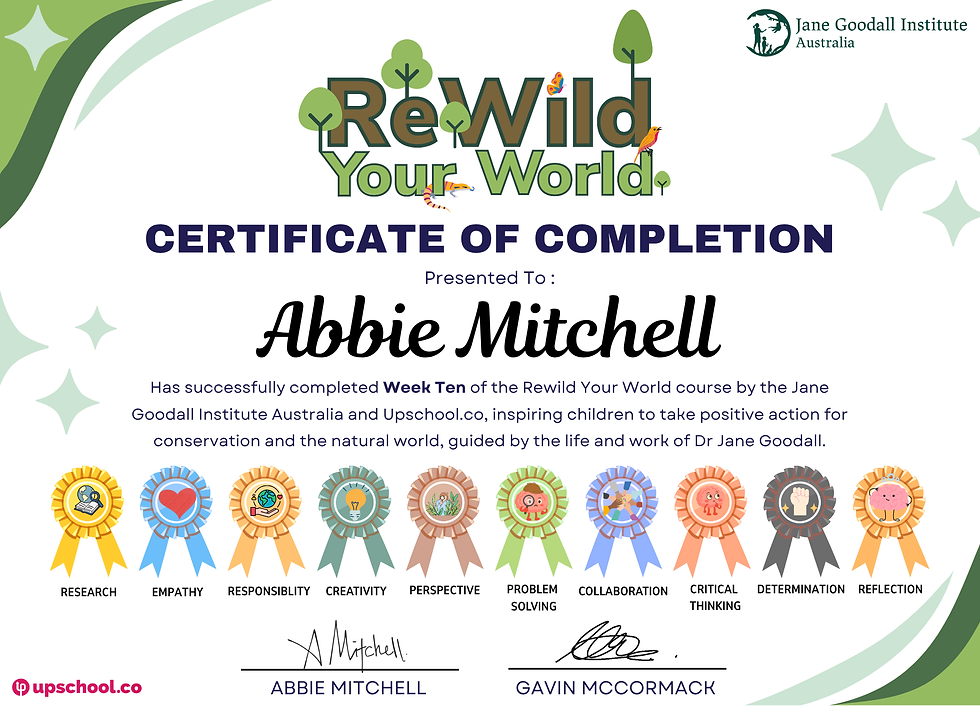
When you finish the quiz, you will receive your final certificate for the Rewild Your World programme.
This certificate celebrates the knowledge, skills and values you have gained throughout this course. Congratulations on your achievement!
.png)