
Skills for Tomorrow
Month 3 - Responsibility
.png)
Introduction. The Power of Responsibility
Begin by introducing responsibility as an essential life skill. Talk with the class about what it means to take care of ourselves, our belongings, our friends, and our environment. Help children understand that being responsible makes our classroom feel calm, safe, and happy.
After watching the David Attenborough video, guide a conversation about how he cared for the world. Ask the children to notice how he respected nature, protected animals, and made thoughtful choices. Look for early skills such as caring for living things, following routines, showing kindness, and thinking about the consequences of actions.
Encourage the children to share times when they have shown responsibility at home or at school. Help them notice how it felt to be trusted and how their responsible choices helped others. This sets the tone for the month and shows that even small actions can make a big difference.
This month we are learning about another important life skill. Responsibility. This means taking care of ourselves, our things, our friends, and our world. When we are responsible, we make good choices, we try our best, and we do what needs to be done even when it feels a little tricky.
We will begin by watching a short animated video about Sir David Attenborough, a man who has spent his whole life looking after our planet and teaching people about the beauty of nature. After the video you will talk together as a class. How did David show responsibility? What did he do to protect the animals and places he loved? How did his choices help the world?
Then, just like David Attenborough, you will take on your own responsibility challenge. It might be caring for something in the classroom, helping to look after a special place, or choosing one action that shows the world you can be trusted to do what is right.
Throughout the month you will discover that responsibility is not about being perfect. It is about trying, caring, and doing little things every day that make a big difference. You will learn that when you take responsibility, you feel proud, confident, and ready to help others.
Remember, responsibility begins with small actions. When we each do our part, our class, our school, and our world become better places for everyone.
Print Your Skills for Tomorrow Booklet
Help children personalise their Responsibility Booklet. Explain that it will be their special place to record how they have taken care of themselves, their belongings, their friends, and their environment throughout the month. Model how to write simple reflections and how to notice moments when they made good choices.
Support the children in understanding that keeping track of their own progress helps them feel proud and builds a sense of ownership. Look for fine motor skills during writing and drawing, clear communication as they share their thoughts, and growing self-awareness as they reflect on the responsible actions they take each day.
As you begin this month’s challenge, you will need a special place to record all the progress you make. We have created a Responsibility Booklet just for you.
Print your own copy and, as you complete each activity, fill it in to show the choices you made, the things you cared for, and the moments you felt proud of being responsible. One day, when you finish the whole course, you will be able to look back and remember how you learned to take care of yourself, others, and the world around you.
Remember, there are twelve booklets to collect during your journey.


Tell Us About Yourself. My Favourites
Use this activity to help children recognise their individuality before they explore responsibility. Guide gentle conversations about what makes each child unique and how the things they care about can help them make responsible choices.
Look for self awareness, confidence when sharing personal information, and respect for the interests of others. Encourage children to notice similarities and celebrate differences. This creates a calm and inclusive foundation for understanding that everyone has things they value and things they want to take care of.
Before we start this month’s journey, we would love to know a little bit about you.
On the first page of your booklet, tell us a few things about your favourite things. Then use the box to draw a lovely picture of them and colour it in to make it bright and cheerful.
This is your chance to make your booklet truly yours, so have fun and be creative. Remember, responsibility begins with knowing yourself, knowing what matters to you, and taking care of the things you love.
.png)
Read This Week’s Story. ‘The Boy Who Loved the World'
Read or play the David Attenborough story and guide a calm reflective discussion on how responsibility shaped his life. Ask the children how caring actions, thoughtful choices, and respect for nature helped him protect the world and inspire others.
Look for comprehension skills, early critical thinking, and connections to real life moments when the children have cared for something or taken responsibility. Encourage them to share examples of times they have looked after a pet, tidied a space, helped a friend, or made a choice that kept someone safe. This story sets the emotional tone for the month and helps children understand that responsibility can make a real difference in the world around them.
Each month, you will read the true story of a remarkable person who shows us how to use the skill we are learning to practise.
This week, we are focusing on responsibility, and we will be reading the story of Sir David Attenborough, the boy who grew up to care deeply for nature and protect the living world.
David was born in England and spent his childhood exploring forests, ponds, and fields. He loved animals and wanted to understand how every creature played a part in the natural world. As he grew older, he felt a strong responsibility to look after the planet and teach others why it is important to care for every living thing. Through kindness, curiosity, and thoughtful actions, he helped millions of people learn how to protect the Earth.
Read or listen to the story opposite, then talk with your friends about what you learned from David’s journey.

Comprehension Questions. David Attenborough and Responsibility
Guide children in choosing another responsible figure from the list. Talk with them about how this person showed care for others, made thoughtful choices, or helped protect something important. Support the children as they look for simple, age appropriate facts and encourage them to talk about their findings with their friends.
Look for curiosity, questioning, and confident sharing during this research time. This task strengthens communication, early planning, and presentation skills while helping children understand that responsibility can create real and positive change in the world.
To learn more about this inspiring person and how he developed the powerful skill of responsibility, read the story opposite carefully.
Look at the questions, explore the key vocabulary, and try to fill in the missing words in the sentences.
Work with the friends around you to complete your task card. Talk about what you have learned, ask each other questions, and share your ideas.
Let us discover how David Attenborough cared for the natural world and showed us that when we take responsibility for our planet, we can help protect it for everyone.
.png)
Research. Choose Your Inspirational Person
Guide children in choosing another responsible figure from the list. Talk with them about how this person cared for others, protected something important, or made choices that helped the world in some way. Support their research by helping them find simple, age appropriate facts and encouraging them to discuss these with their peers.
Look for curiosity, questioning, and growing confidence as they share what they have learned. This task strengthens communication, early planning, and presentation skills while helping children see how responsibility can lead to real and positive achievements.
Now that you have learned all about David Attenborough and how he used responsibility to care for the natural world, it is your turn.
Choose one of the twelve inspirational people from our list. Once you have chosen, go home and do your own research about them. Use your research booklet to record three amazing facts about how they showed responsibility and looked after something important. Then draw a picture of them to bring your research to life.


Choose Your Challenge
Introduce the idea of a month-long responsibility challenge. Help the children choose simple, realistic actions they can continue each day, such as caring for a class plant, keeping a tidy workspace, helping to look after shared materials, or completing a small daily task that shows responsibility.
Encourage gentle goal setting and personal ownership. Look for initiative, thoughtful planning, patience, and steady effort. Use circle time to talk about progress, celebrate successes, and solve small problems together. This helps children understand that responsibility grows through daily actions and consistent care.
Now that you are becoming an expert on responsibility, it is time to start strengthening this skill in your own life.
This month, we want you to choose one responsible action and keep doing it for the whole month. The secret to building responsibility is to care, to try your best, and to make thoughtful choices even when it feels a little difficult.
Look at the list of possible responsible actions and pick one that you believe you can keep doing until the very end of the month. Once you have chosen, write down why you picked that challenge and what you hope to achieve by taking responsibility each day.


Let us Make Something
Encourage the children to look at the list of fifty creative options and choose one on their own. Explain that this is their chance to decide how they would like to show what they have learned about David Attenborough.
Give them time to plan and gather what they need. Look for independence, thoughtful choices, and personal expression. Remind the children that their work should teach others something important about David’s life and how he showed responsibility by caring for the natural world.
With your new knowledge of David Attenborough, it is time to make something that shows how much you have learned about his life. There are fifty different options to choose from. Pick just one.
You can work with your friends or on your own to create something special about his story. Use your project to teach others about the remarkable life of David Attenborough and the way he encouraged people all over the world to care for nature and protect our planet.

Keep on Track. Responsibility in Action
Model how to record daily responsible actions and support the children as they complete their checklist. Talk together about what went well each day and what could be improved. Use this time to highlight the importance of consistency, gentle reflection, and taking ownership of personal choices.
Look for clear communication, growing independence, and thoughtful decision making. Encourage children to recognise their own efforts and to celebrate when others show responsibility too. This builds confidence, strengthens community, and helps them understand that responsible actions create a positive classroom environment for everyone.
This is the part of the course where you keep building your responsibility skills and show how your daily choices make a difference.
We have created a daily checklist for you to write one simple sentence each day about how you showed responsibility. It might be caring for something, tidying a space, helping someone, or making a thoughtful choice that kept your challenge going.
If you are looking after a class plant, tell us what you did today. If you have chosen to keep your area clean, write down how you cared for it and what you noticed. This part is all about showing that small responsible actions add up to something important.
At the end of each week, take a photo, print it, and stick it in the space provided as proof that you are moving forward and taking responsibility every day.


Reflection and Quiz. Month Three
Facilitate a gentle reflective conversation about what the children have learned about responsibility this month. Support them as they complete their written reflections and their online quiz.
Look for evidence of self assessment, an understanding of what responsible choices look like, and recognition of how responsibility has helped them grow. Celebrate their efforts with a small class moment of recognition and encourage them to share examples of times when they felt proud of the choices they made.
You have now completed the third month of your Kindergarten Diploma and you are moving closer to earning your full certificate at the end of the year.
There is still a journey ahead, but this is the moment to pause and think about how you feel after spending a whole month learning about responsibility and caring for the world around you. Take your time to answer the questions opposite in your Skills for Tomorrow booklet. Then complete your online quiz by clicking the button below.
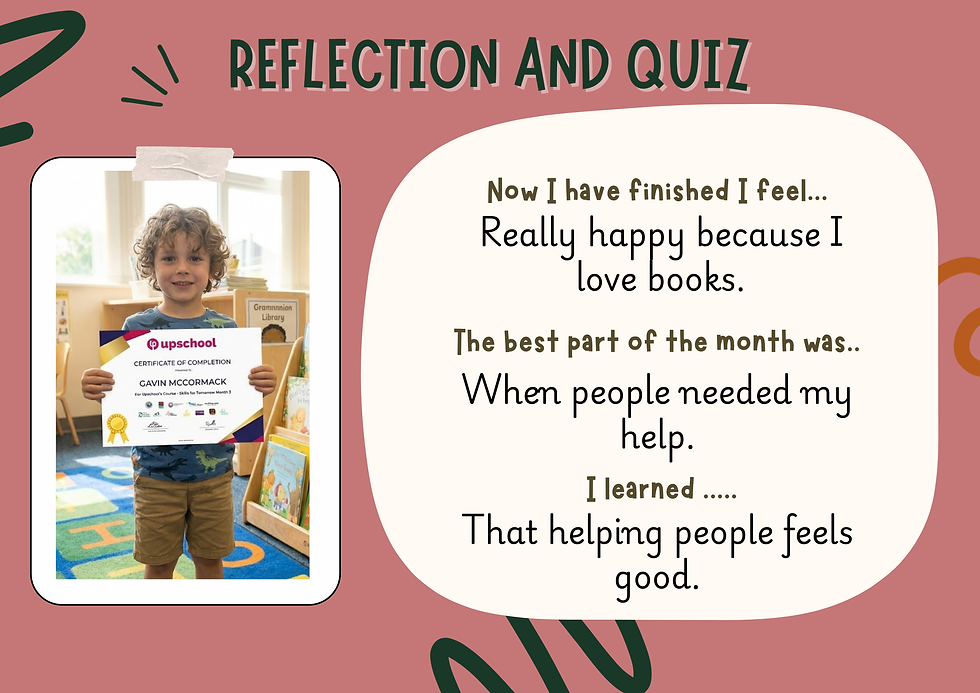
When you are finished, take a photo of yourself holding your certificate and place it next to your sentences to celebrate completing Month Three of this special journey we are on together.
Well done for showing the power of responsibility in your everyday actions.
Getting Your Certificate
This final step builds reflection, recall, and self-assessment skills. The quiz reinforces students’ understanding of determination, resilience, and growth while rewarding their effort with certification. Encourage learners to view the certificate as a symbol of their personal progress, not just a score.
Consider reviewing key ideas beforehand, offering support where needed, and celebrating every student’s achievement. Extension: invite learners to share one way they will apply determination in their own lives to strengthen lasting impact.
You have explored the power of responsibility — discovering how caring, making good choices, and doing what needs to be done can help you and others every day. To celebrate your journey, you will now complete a short quiz on the skills and lessons you’ve gained this month.
If you achieve 80% or more, you will proudly receive your certificate. This is a way of honouring the effort, care, and thoughtful choices you have shown throughout this course.
Well done for learning how responsibility can create real change — and for proving that when we take responsibility, we help make our classroom, school, and world a better place.
