

Rewild Your World
Week 5 - Your Habitat Survey
.png)
Know Your Habitat
Begin the week by reflecting on prior learning about biodiversity and connectivity. Revisit key ideas such as how plants, animals, and ecosystems depend on each other to stay healthy. This reflection will help students connect new learning with prior knowledge.
Students will step into the role of young environmental scientists by carrying out a habitat survey of their school grounds. They will explore new scientific vocabulary, consider Steve Irwin’s message, and learn how the return of the Eurasian Beaver helped restore wetlands across Britain. These activities deepen their understanding of how species and habitats depend on each other.
Students will read about ecosystem engineers and keystone species, then continue Research Part 2 to strengthen their knowledge of their Champion Animal. They will develop mapping skills by drawing a bird’s eye view of their school and use it during their outdoor survey to record and score habitat features. Back in class, they will create bar graphs, combine class data, and use a simple equation to calculate an overall habitat score.
These steps build mathematical reasoning and scientific thinking.
This week, you will step into the shoes of real environmental scientists! You’ll get to know your Champion Animal even better and explore your school to see whether it has everything your animal needs to survive.
You’ll learn new scientific words, read stories about animals that shape their habitats, and discover how creatures like beavers and bees transform the world around them. You’ll draw a bird’s-eye view of your school, walk around the grounds like detectives, and look for clues such as food, water, shelter, breeding spaces, and safe pathways.
You’ll score what you find, create a bar graph, and help your class calculate a full habitat score. You’ll also enjoy a calm mindfulness activity by searching for camouflaged animals, and then share your discoveries in a Dear World story.
Finally, you will complete.....
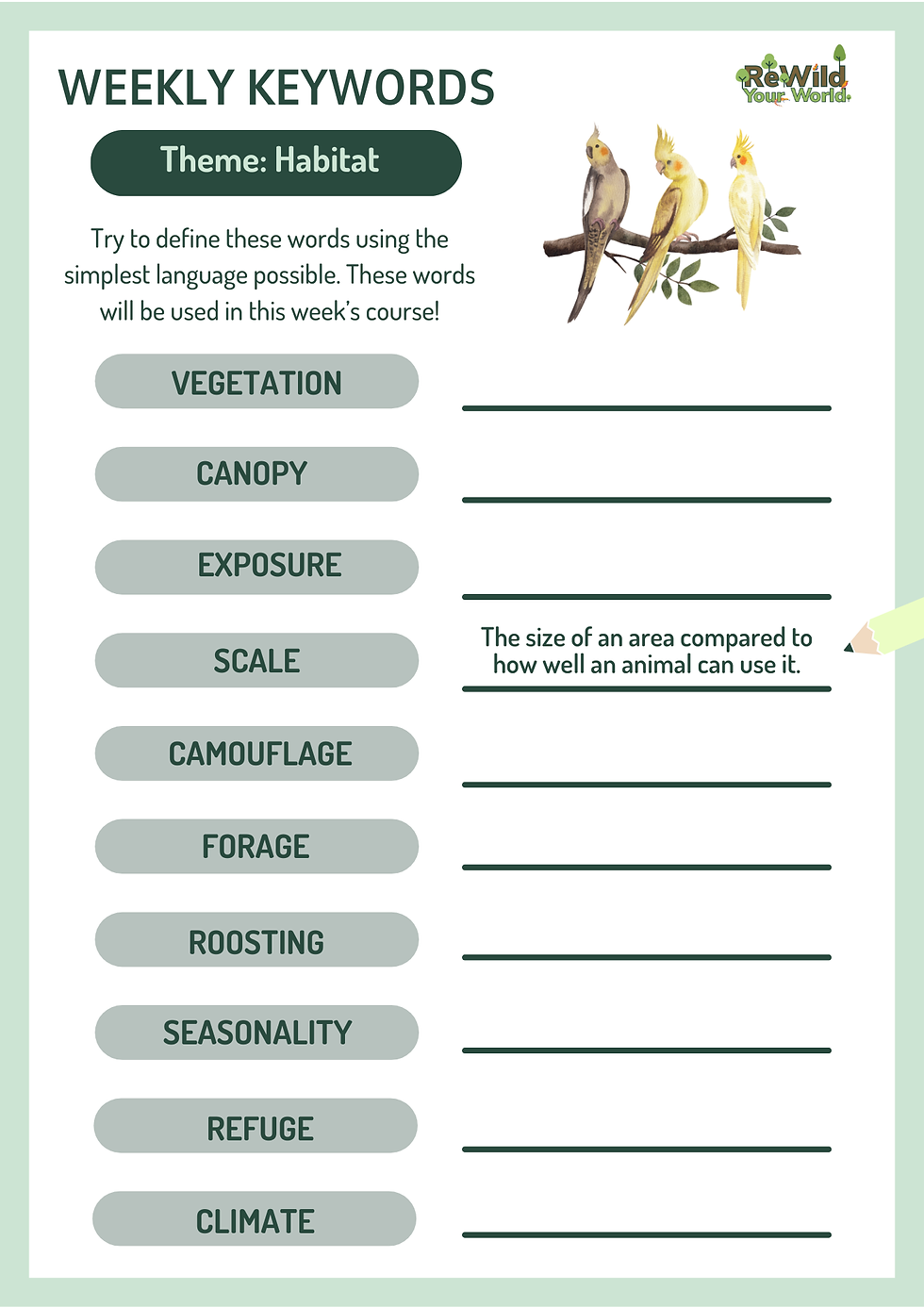
Your Weekly Keywords
Support students as they explore this week’s vocabulary by modelling how to use context clues and trusted resources to discover word meanings. Encourage them to connect familiar ideas, such as habitats and ecosystems, with new terminology related to data collection and fieldwork. Remind students that they are defining these words in an ecological sense, and that some words, like exposure, may have multiple implications for an animal.
Guide students to work collaboratively, discussing their thinking and justifying their choices as they match words to definitions. Observe how they identify patterns, notice relationships between concepts, and use scientific language with increasing accuracy.
This week, your new set of keywords will help you carry out a habitat survey with confidence and curiosity. Each word connects to the places where living things make their homes and the clues we look for when studying an environment. Some words may feel unfamiliar at first, but each one will strengthen your scientific vocabulary and help you think more deeply about the relationships between animals, plants, and their surroundings.
Your task is to provide a simple definition for each word. You may need to do a little research to discover what each word means, so take your time and work carefully. Use books, digital tools, or class resources to guide you.
These words will support you when you plan and carry out a habitat survey accurately and safely later in the week.
As you work, talk with a partner about what you notice. Which words describe the different parts of a habitat? Which ones explain how scientists collect information? Which connect to what you already know about biodiversity and ecosystems?
By the end of this task, you’ll have a clearer understanding of how to observe the world around you and record your findings like a real environmental scientist.
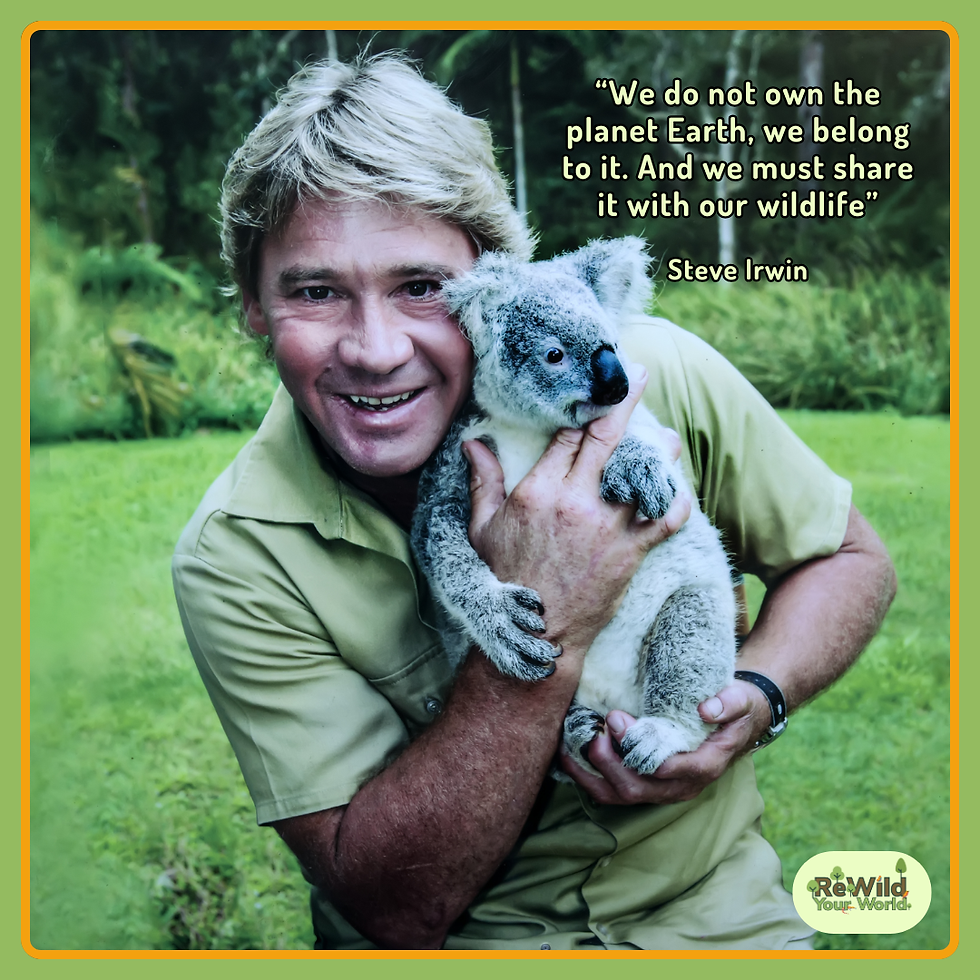
Quote of the Week - Steve Irwin
Invite students to explore the meaning behind Steve Irwin’s words and discuss why they still matter today. Highlight the idea that humans are part of the same living system as every plant and animal, and consider how this shapes our responsibilities in caring for the environment.
Remind students that a short message can express a powerful idea, focusing on clarity, emotion, and purpose—just like the quotes studied in previous weeks. Encourage them to reflect on their recent learning about habitats and the creatures that depend on them.
Guide students to create their own quotes that show understanding, empathy, and a desire to protect the natural world.
“We do not own the planet Earth, we belong to it. And we must share it with our wildlife.” – Steve Irwin
This week’s quote reminds us that we are part of nature, not separate from it. Everything around us, from the tiniest insect to the tallest tree, shares the same home.
As a class, spend some time talking about what Steve Irwin meant with these words. Think about who he was, the work he did, and why he cared so deeply about wildlife.
After your discussion, use the template to create your own original quote about caring for the places animals live. Consider what you believe, what you value, and how your words might inspire others to look after the natural world. Let your message be simple, strong, and full of heart.
Encourage students to reflect on our relationship with nature and think about how they can express this connection through words.
.png)
Story of the Week - The Return of the Eurasian Beaver
Begin by revisiting the idea of rewilding and how people can help restore balance to an environment by supporting key species. Introduce the terms keystone species and ecosystem engineer using the Eurasian Beaver story.
Highlight how one species can modify an environment for many others (ecosystem engineer) and is vital for the functioning of an ecosystem (keystone species). The return of the beaver helped restore wetlands, increase biodiversity, and strengthen whole ecosystems.
Encourage discussion about the power of natural engineering and how beaver activity creates habitats for many other species. Guide students to notice the role of community cooperation, including how concerns were addressed and how people worked together to find solutions.
This week, read the story on the task card opposite about the return of the Eurasian Beaver in Britain. You will learn how beavers once shaped the land, how they were hunted and disappeared, and how scientists and communities worked together to bring them back.
As you read, think about how one animal can benefit many others and how the land changed when the beavers returned. Then reflect on what this story can teach you about protecting your own Champion Animal.
Remember, even small steps can help nature recover when people work together.


Comprehension – Shifters and Shapers of Ecosystems
This comprehension task helps students develop deeper reading skills through literal, inferential, and applied questioning. Reinforce that:
Literal questions focus on what the text states directly.
Inferential questions explore what the author suggests or hints at.
Applied questions encourage students to connect the information to real-world contexts and their own observations.
Guide students to use evidence from the text to support their ideas. Encourage them to notice how each ecosystem engineer or keystone species affects the wider environment and why these roles are important for ecosystem balance.
Prompt students to consider how this information links to their upcoming habitat survey and Champion Animal research. Support them in recognising patterns, relationships, and cause-and-effect within ecosystems. Provide feedback that values careful reasoning, curiosity, and thoughtful connections between the text and real environmental challenges.
This week, you will read an information text about ecosystem engineers and keystone species, animals that play an important role in shaping and supporting the environments they live in.
As you read, focus on how these creatures change their habitats or help to balance ecosystems in ways that help other species survive. Notice how digging, grazing, spreading seeds, moving nutrients, building shelters, and predation can transform entire ecosystems.
This text will help you understand the kind of information you will need when you carry out your own habitat survey. It will show how animals influence soil, water, plant growth, and the balance of life in an area.
Read the content carefully, as you will answer comprehension questions afterward that move from finding information to thinking more deeply and critically about how ecosystems work.
As you work, take notes on key examples that explain how ecosystem engineers and keystone species keep environments healthy. Think about how these ideas connect to your Champion Animal and how your own observations outdoors can help you understand the relationships that exist within your local habitat.


Record Your Answers – How Far Can You Go?
Let students know that the comprehension task is organised into four stages that become more challenging as they go. The aim is for them to move from basic recall toward interpreting ideas and applying them to real ecological situations.
Encourage students to work steadily through each level and to respond in full sentences that draw directly on the information in the text about ecosystem engineers and keystone species.
Use the template provided to research other examples of engineers and keystone species with an emphasis on local or regional species. You can revisit the Atlas of Living Australia for a list of locally occurring species.
After reading the information about ecosystem engineers and keystone species, you will answer twelve comprehension questions that become more challenging as you move through the levels.
You will begin with Level 1 questions that ask for simple facts and work your way toward Level 4 questions that invite you to think deeply, make connections, and apply your understanding to real environments.
Write your answers in full sentences and use evidence from the text to support your ideas. Take your time and read each question carefully before responding.
If you find a question challenging, pause and think. That moment shows your understanding is growing and that you are ready to explore new ideas about how animals shape ecosystems, support biodiversity, and influence the places where they live.
Use the template in the answer sheet to create your very own list of keystone species and ecosystem engineers from your local area or region.


Researching Your Champion Animal - Part 2
Encourage students to keep building their knowledge of their Champion Animal by using a range of reliable sources. They can read books, explore trusted websites, or speak with someone who knows a lot about animals.
Remind them that checking facts in more than one place helps ensure their information is correct, especially as AI-assisted searches can sometimes produce inaccurate information. Request that students keep a list of references that they can return to at any time.
Part 2 focuses on understanding the challenges the animal faces and the ways it survives in its habitat. Students will use this knowledge later when they think about how people can help keep the species safe and healthy. Their findings will become part of the class book, so clear, careful research is important.
This week, you will continue the research you started last week so that you can become a true expert on your Champion Animal. Look at the task card opposite. You will see new questions that help you explore how your animal lives, the challenges it faces, and how it interacts with other living things in its habitat.
To answer these questions, you will need to research carefully. Use books, trusted websites, or talk to someone who knows a lot about animals. Try to use at least three different sources so your information is clear and correct.
Remember that this is Part 2 of your research. You are building on what you learned last week so you can know almost everything there is to know about the animal you have chosen.
Make sure you look at the modelled example about the Striped Possum. It will show you exactly what your work should look like and how to set out your ideas.
When you have gathered your new facts, you will create a page that shares everything you have learned. Each student will make one page, and these will be joined together to make a class book that celebrates every Champion Animal.
Take your time, stay curious, and enjoy discovering even more about the animal you are protecting.


Creating Your Champion Animal Resource
Encourage students to view this task as a moment of genuine choice and ownership. The wheel gives each child a fair starting point, but the freedom to spin again helps them select a resource idea that feels exciting and meaningful to them. This supports agency and ensures students begin their project with enthusiasm rather than obligation. You may wish to limit it to three spins from which they can make a choice.
Prior to the spin, guide students to think about the purpose behind what they are making. Their resource is not simply a classroom activity—it is a teaching tool that must clearly communicate key information about their Champion Animal. Support them in checking the accuracy of their facts and the clarity of their message so that someone unfamiliar with the species could learn from their work independently.
Now that you are an expert in your Champion Animal, it is time to create a resource that teaches others what you know. Start by spinning the class wheel. If the idea you land on doesn’t excite you, spin again until you choose one you are truly keen to make.
You will have five days to create your resource, working in class and at home. Make sure it clearly shows how your animal lives, what it needs, and why it matters. It should be something others can read, watch, or explore to learn from your work.
At the end of the week, you will present your creation to the class. After sharing it, decide what you want to do with it next. You might donate it to another school, give it to a younger child, share it with your family, or send it to a community that could benefit.
Create something you are proud of, something that teaches and inspires others about your Champion Animal.

Mapping Your School from Above
Support students as they learn to imagine their school from a bird’s-eye perspective. Begin by inviting them to close their eyes for a moment and picture what the school might look like from above. This simple visualisation helps them understand that maps are drawings of real places seen from a different point of view.
Explain how the grid on the paper acts as a guide. It helps with estimating distances, keeping proportions steady, and placing each part of the school in the correct position. Model how to count squares, compare sizes, and use simple grid references to describe where objects sit on the map. You may wish to measure some key features, such as the school fence or buildings, and determine a scale to guide the drawing. You may also wish to take a compass reading and add that to the map.
In this activity, you will imagine that you are a bird flying high above your school. Using gridded paper, a sharp pencil, and a ruler, you will draw a map that shows your school buildings, playgrounds, gardens, paths, and any surrounding areas.
If available, you may choose to look at Google Maps or use the fire evacuation chart on the wall. These can help you see the layout clearly and check that your shapes and positions are correct.
Start by looking carefully at the shapes of the buildings and how the different spaces connect. Use the grid to help you estimate distances and keep your lines straight. Try to draw each section in the correct place so that your map looks as close as possible to the real view from above.
Take your time and work neatly. This map will be used in the next activity when you conduct your habitat survey, so accuracy is very important. The more precise your map is, the easier it will be to record the living things you find around your school.


Habitat Survey - Exploring Your School Habitat
Introduce the habitat survey as a chance for students to discover the natural features that already exist around their school. Explain that their goal is to observe like young scientists, paying attention to details they may not have noticed before. Encourage them to slow down, look closely, and enjoy finding things that connect to the needs of their Champion Animal.
Remind students to consider any seasonal activity of their champion animal and if this survey is representative of when the animal could be locally active (for example if it is a migrating species or its activity is dependent on a seasonal lifecycle as is the case for many insects).
Guide students to use their maps as tools for recording evidence. Have them add a key to the map indicating food, water, shelter, breeding sites and connectivity. Model how to match what they see in the environment with a point on the grid so that their markings are clear and accurate. Remind them that careful identification matters, because the information they collect will be used in the next step when they give the habitat a score.
Now that you have created your map, it is time to begin your habitat survey. Before you walk around, read the information in the example and observe how we have completed an example of the survey based on the ringtail possum. Add a coloured key to indicate:
Food
Water
Shelter
Breeding sites
Connectivity
You will then walk around your school grounds and look for the parts of the environment that could support your own Champion Animal. Use your gridded map as your guide and mark any features that might help your animal live, grow, and stay safe.
These features help animals survive and keep the habitat healthy. Try to be as observant as a detective. Look closely at plants, soil, water, shade, and open spaces. Think about all the things you have learned so far and even consider the area from the animal’s point of view.
Each time you find a useful habitat feature, mark it clearly on your map. For example, a flowering shrub might be marked as a food source, a hollow tree or dense bush could be shelter, a pond or dish might provide water, and connected trees or fences could help animals move safely across the area. This evidence will help you in the next activity when you give your school habitat a numerical score based on your findings.
Take your time, move safely, and enjoy noticing the living world that surrounds your school every day. Your careful observations will help you understand whether your Champion Animal could survive here and what the habitat might need to be improved to create a sustainable habitat.


Giving Your School a Habitat Score
Guide students to see the scoring activity as more than simply adding numbers. This task is an opportunity for them to think critically about what their observations actually mean for the survival of their Champion Animal.
Encourage students to look back at their maps, recall their fieldwork, and use real evidence to justify the score they choose for each part of the habitat.
Support students in thinking deeply about why a habitat feature is helpful or unhelpful. Ask questions such as What does this area provide?, How would my animal use this?, and Is this feature strong enough to support the species? Would it still work in different seasons or times of day? These questions help students consider the quality of the habitat rather than counting features without reflection.
Remind students that scoring requires honesty and accuracy. A high score should only be given when the environment truly meets the needs of their animal. A low score is not a failure but important information that helps students understand what the habitat is missing.
Now that you have completed your habitat survey, it is time to give your school a numerical score. This score will show how well your school can support your Champion Animal. You will look at the five important parts of a habitat identified during the survey:
Food
Water
Shelter
Breeding sites
Connectivity
For each part, you will give your school a score out of three. Use the score guide on the task card opposite.
For example, if you found different places where your animal could drink water, consider how suitable the access is for your Champion Animal. It may be hard to get to or not reliable—meaning, even though there is water, you might only give it a score of 1 or 2. If it is perfect, it would get a score of 3. If you found no water at all, you would score a 0. You will need to put on your critical thinking hat and consider it from the animal’s point of view.
Once you have scored each of the five areas, add the numbers together to get your final habitat score. The highest possible score is 15. This total will help you understand how suitable your school environment is specifically for your Champion Animal and where improvements might be needed.


Turning Your Data into a Class Score
Encourage students to work together as they turn their individual habitat scores into a shared class data set. Explain that scientists often compare results from many people to build a clearer picture of what is happening in an environment. This helps students see the value of collaboration and teamwork.
Guide students as they combine their scores and use the equation to calculate the overall class habitat score. Support them in understanding that each student’s data contributes to the final result, and that everyone’s observations matter.
Once the class score is calculated, prompt students to think critically about what the numbers suggest. Invite them to look for patterns and differences between students’ findings. Ask open questions such as:
What do we notice?
What might this tell us?
Why do you think this happened?
These questions help students move beyond the numbers and consider the real meaning behind the data.
Now that you have scored your school habitat, start by making a bar graph. Use the task card to help you set up five bars for food, water, shelter, breeding sites, and connectivity. This graph shows your results in a clear and easy way.
You will also assess the pros and cons of the area and provide your final assessment, including a reflection on how your Champion Animal might access your site.
Once complete, your class will put all the scores together. First, work out the highest score your class could get using this equation:
Number of students × 15 = Total possible score
Next, add all the individual scores from your classmates. This gives you the total points achieved. You can then compare these two numbers to see how well your school habitat supports all the Champion Animals.
After the calculation is complete, look at your own results and the class results. Think about what the numbers mean. Ask yourself:
Which parts of the habitat scored the best?
Which parts scored the lowest?
Why might this be happening?
Use this information to help you understand the strengths and weaknesses of your school environment. This reflection will help guide your ideas in the next tasks.


Weekly Mindfulness – Camouflage
This mindfulness activity invites students to slow down and notice how animals hide within their surroundings. Encourage them to step outside quietly, breathe calmly, and allow their senses to guide their observations. Remind them that camouflage often works so well that creatures will not stand out, so patience and careful looking are essential.
Guide students to focus on subtle details such as colour blending, repeating patterns, shadows, textures, and small movements in leaves, bark, soil, and branches. Prompt gentle questions such as What helps this creature stay hidden? or Why might this pattern protect it? These simple prompts help students build awareness of how animals depend on their environment for safety.
Model this calm and attentive behaviour by joining the activity yourself. Sketch alongside the students and write a short rhyme or reflective line to show that mindfulness and creative expression are for everyone. This helps create a peaceful and focused atmosphere outdoors
This week, you will spend quiet time outdoors looking for animals that are hiding in plain sight. Many creatures use camouflage to blend into their surroundings so they can stay safe from predators or sneak up on their prey.
Walk slowly through your school grounds or garden and look very carefully at leaves, branches, bark and rocks. Some animals will be so well hidden that you may need to crouch down or look twice before you spot them. Look carefully at bark or in leaves. You may like to use a magnifying glass if you have one.
Bring your sketchbook or task card and choose one or two camouflaged creatures or hidden features to observe closely. Use your pencil to draw what you see and focus on the tiny details that help the animal stay hidden. Look at the colours, patterns, shapes, and textures that allow it to blend into the background.
After drawing, try writing a short rhyme or simple poetic line about your discovery. You might create something like
I sit on the bark, so quiet and still,
Blending with patterns until danger is nil.
Let your rhyme show how the animal disappears into its world.
Take this time to slow down, breathe calmly, and enjoy noticing how clever animals are at hiding themselves. This is your chance to pause, observe, and appreciate the secret world of camouflage all around you.


Your Digital Résumé – Experience 5
Encourage students to use their digital résumé as a place for real reflection, not just a list of what they have done. Guide them to think about how completing the habitat survey has changed the way they see their school grounds and the animals that might live there. Help them recognise how this experience has strengthened their curiosity, confidence, and understanding of the natural world.
Support students in using digital tools to present their reflections clearly. Show them how to organise their thoughts, choose a layout, and personalise their page so it truly represents their voice. Remind them that their writing should show what they felt, what they learned, and how they have grown.
This week, you will add your fifth experience to your digital résumé by reflecting on your habitat survey. Think about what it felt like to walk around your school grounds with careful eyes, searching for the things your Champion Animal would need to survive. You might reflect on using your map, spotting important habitat features, or working like a real scientist to collect and record your data.
You could write about discovering something you had never noticed before, or how it felt to score your habitat and think about what your school environment does well and what it still needs. You might also reflect on working with your classmates to calculate the class score and seeing how everyone’s findings came together.
Each reflection helps show how much you are growing as a thoughtful observer and a protector of the natural world. By adding your ideas to your digital résumé, you are showing how your curiosity, responsibility, and problem solving continue to develop as you move further into your Rewild Your World journey.


Share Your Thoughts on Dear World
This week, students will write and share a Dear World story based on their habitat survey. Encourage them to think about what stood out, such as mapping the school, spotting habitat features, or scoring each part of the environment. Help them notice how these moments deepened their understanding of their Champion Animal.
Invite students to reflect on the values they used, including curiosity, responsibility, teamwork, and careful observation, and how these helped shape their view of their school habitat.
Support them in writing a short story that shows their learning and personal growth. When finished, they can upload their reflection to the Dear World Library with photos of their map or graph.
Celebrate stories that show thoughtful reflection and care for nature. Remind students that their voices can inspire others to protect the places where animals live.
This week, you will write a Dear World story based on your habitat survey. Think about what it felt like to explore your school grounds with your map, spot important habitat features, and score each part of the environment. You might write about something surprising you noticed or a moment when you felt like a real scientist.
Reflect on the values you used, such as curiosity, responsibility, and teamwork, and how they helped you understand your Champion Animal’s needs.
When you are ready, log in to the Dear World Library and upload your story. You can add photos of your map or graph to bring it to life. Use your words to inspire others to care for habitats and protect the animals that depend on them.
.png)
Week 5 Quiz and Certificate
Explain that the habitat survey quiz can be completed by following the online link provided. Students may complete it either in class or at home. Encourage them to talk through their ideas with a partner before submitting their answers, as sharing thinking helps build understanding.
Remind students that the certificate for this week is awarded to each person individually, so everyone needs to complete their own quiz. Emphasise that this is not a test. It is a chance for students to reflect on what they have learned, review the key ideas from the week, and celebrate how much their knowledge has grown.
As students work, observe their independence, digital confidence, and willingness to collaborate. Look for signs of perseverance, thoughtful answers, and increasing accuracy. These moments show their growing understanding of habitats, the needs of animals, and the importance of caring for the natural world.
At the end of this week, you will complete a short quiz to reflect on everything you have learned about habitats and how well they support different animals. Throughout the week, you have mapped your school grounds, carefully observed different spaces, and scored each area based on how suitable it is for your Champion Animal.
Along the way, you have also been developing something very important: perspective. You have practised looking at your environment not just as a student, but through the eyes of another living being. You have asked yourself, What would this space feel like if I were my animal? Would I feel safe? Would I find food, shelter, and water here? This ability to step into another point of view is a powerful skill that will stay with you far beyond this project.
The quiz is simply a moment to pause and think about how your understanding has grown. It is not just about remembering facts, but about recognising the connections between animals, plants, habitats, and the choices we make as humans.
Once you have completed the quiz, you will receive your Week 5 certificate. This certificate celebrates your expanding knowledge, your curiosity, and your increasing ability to see the world from different perspectives.
There are ten certificates to collect across your Rewild Your World journey.
By the end of the course, your full set will represent not just what you have learned, but who you are becoming: a thoughtful, observant, and caring guardian of the natural world we all share.
.png)